Fundamentals - PIERRE Pro System (Wired Installation)
Description
PIERRE PRO is the wired system solution of the PIERRE Smart Home Solution, primarily designed for new constructions, complete renovations, and larger residential and commercial projects.
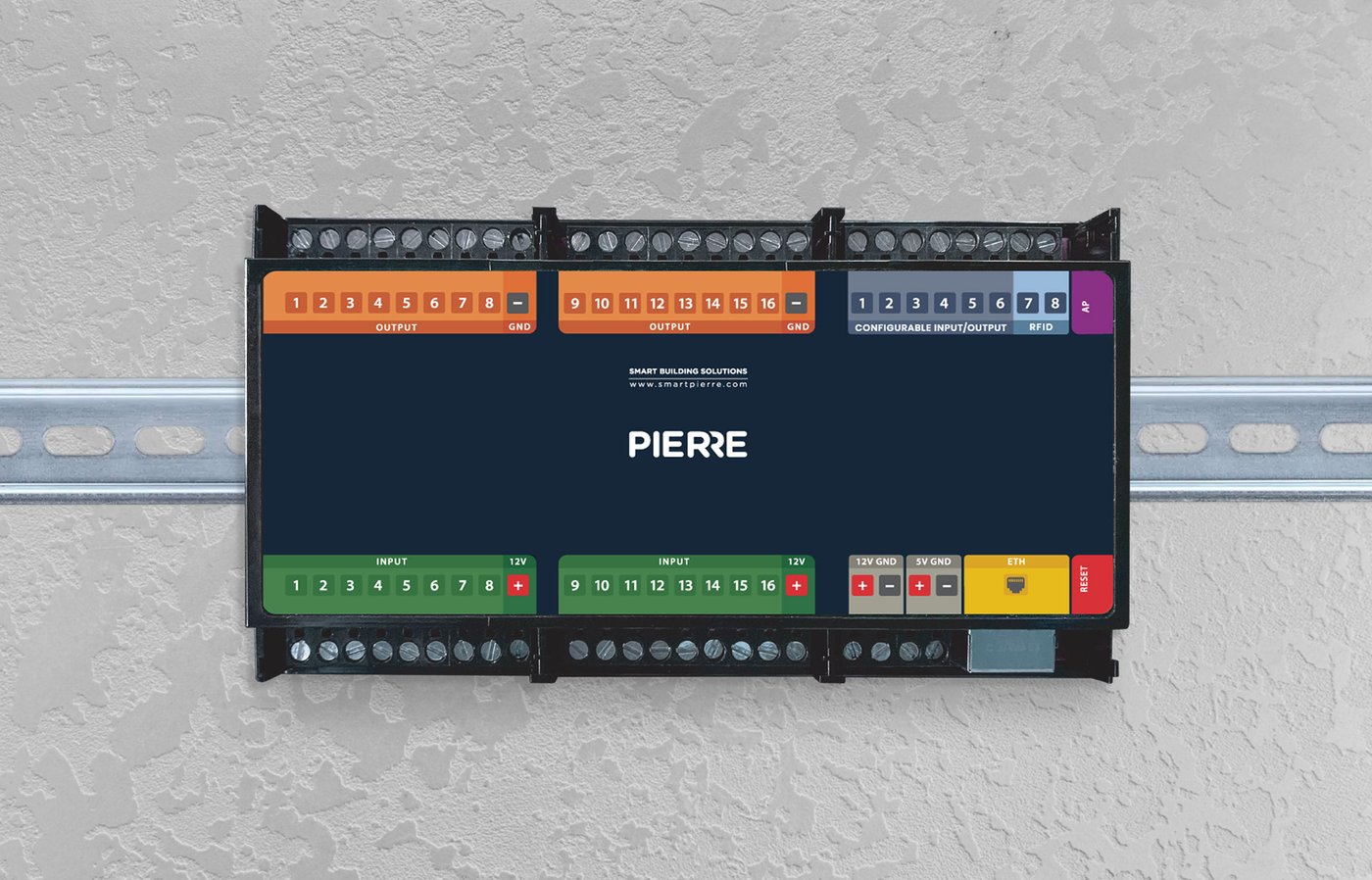
The central component of the system is the PIERRE Controller, which is typically installed in the electrical distribution board. Access control, lighting, shading, irrigation, mechanical systems, heating and cooling, push buttons, and various sensors can be integrated into the system through wired connections according to the technical design of the project.
Thanks to its wired architecture, the basic control functions do not require radio communication between the individual endpoints and the PIERRE Controller.
Wiring Principle
The PIERRE PRO system is primarily based on a centralized wiring architecture.
Switched loads, lighting circuits, motorized shading devices, and other controlled equipment are typically wired back to the PIERRE Controller or the appropriate additional modules installed in the electrical distribution board.
Push buttons and various sensors are also connected to the system through wired connections.
For communication devices, such as Modbus devices, wiring can be implemented using bus, daisy-chain, or – where supported – star topology, according to the communication standard, the technical requirements of the connected device, and PIERRE specifications.
The system wiring must be defined during the design phase. The required mains, control, and communication cabling must be designed and installed to meet the requirements of the connected equipment and ensure compatibility with the PIERRE system.
Applications
The PIERRE PRO system is particularly suitable for:
-
new constructions, where the complete wiring can be planned in advance,
-
complete renovations, where new cabling can be installed,
-
houses and apartments requiring a stable wired automation system,
-
complete residential building projects, where multiple apartments are implemented using a unified system,
-
office buildings and commercial properties,
-
hotels and apartment buildings,
-
larger residential and commercial projects with a high number of control points and integrated functions.
Integrable Functions
The PIERRE PRO system can integrate functions including:
-
access control, intercom, RFID and PIN-code access,
-
lighting control,
-
dimmable lighting,
-
RGB, RGBW, and other LED lighting,
-
roller shutter, venetian blind, and curtain control,
-
heating and cooling control,
-
fan coil control,
-
valves and valve actuator control,
-
irrigation control,
-
sauna and pool control,
-
switchable sockets and other electrical loads,
-
push buttons and switches,
-
temperature, humidity, and other sensors,
-
door and window contact sensors,
-
water leak detection and related protective functions,
-
and other compatible building services and automation devices.
Centralized Architecture
One of the main characteristics of the PIERRE PRO system is its centralized architecture.
The PIERRE Controller, required I/O modules, power supplies, relays, contactors, communication devices, and connection terminals are typically installed in the electrical distribution board.
This centralized architecture provides a clear system structure and simplifies future maintenance, troubleshooting, and system expansion.
Technical Notes
-
The size of the electrical distribution board must be determined during the design phase, taking into account the space required for the PIERRE Controller, I/O modules, power supplies, relays, contactors, terminals, and other required equipment.
-
Sufficient spare capacity should be reserved in the distribution board for future system expansion.
-
Extra-low-voltage signal and communication cables must be separated from mains wiring according to applicable electrical regulations and PIERRE technical documentation.
-
Every cable should be clearly labelled at both ends during installation.
-
Cable identification should correspond with the electrical drawings and PIERRE project documentation.
-
Spare cables should be installed at locations where additional functions or devices may be required in the future.
-
Cable types and conductor sizes must always be selected according to the connected equipment, electrical load, cable length, communication requirements, and applicable electrical regulations.
-
The system must be installed according to the PIERRE technical documentation, electrical drawings, and the technical requirements of the connected equipment manufacturers.