Solution - Elevator Control
Description
The Elevator Control — Floor-by-Floor configuration allows the PIERRE system to manage elevator access through a two-level authorization concept. The first level controls and authorizes elevator calls from individual floors, ensuring that only authorized users can request the elevator from a specific location. The second level controls floor selection inside the elevator cabin, allowing users to use the elevator buttons only after successful authorization.
Each elevator level can be added to the PIERRE system as a Door I/O. Once configured, it can be placed on any dashboard with access to that I/O. This allows authorized users to call the elevator not only through an RFID/keypad reader, but also directly from the PIERRE mobile app or from a display.
For this integration, the elevator control unit must provide dry-contact inputs for call and/or button commands. In most elevator systems, this type of interface is already available because standard elevator push buttons typically operate through dry-contact inputs. The PIERRE controller uses relay dry contacts to simulate these push button commands without directly interfering with the elevator’s internal control logic.
By combining floor-side and cabin-side authorization, the system provides secure and flexible elevator access management. Each user interaction is verified by the PIERRE controller before a command is sent to the elevator controller, creating an additional layer of security without interfering with the elevator's normal operating logic. This approach is particularly suitable for residential buildings, offices, hotels, and other facilities where access to specific floors must be restricted from public.
System Concept
The system works on two access-control levels:
-
Floor-side authorization
Each floor can be equipped with an RFID/keypad reader. This reader is used to authorize the elevator call from that specific floor.
When a user presents an authorized card, tag, or PIN, the PIERRE controller activates the corresponding relay output. The relay sends a dry-contact command to the elevator controller, simulating a floor call button press.
In addition to RFID/keypad authorization, each floor call can be configured as a Door I/O in PIERRE. This makes it possible to add the floor call to dashboards and allow authorized users to call the elevator from the mobile app or from a display.
This does not control or unlock the floor door. It only authorizes and triggers the elevator call from that floor.
-
Cabin-side authorization
An RFID/keypad reader can also be installed inside the elevator cabin. This reader is used to authorize the use of the elevator buttons.
After authentication, the PIERRE controller enables the elevator button functionality, allowing the user to select a destination floor. If authentication is not successful, the elevator buttons remain disabled. The authorization applies to all configured elevator buttons rather than individual floor selections.
Keep in Mind:
When controlling an elevator using a dry contact, the elevator controller requires a dry contact signal from our system. It is essential to verify with the elevator manufacturer which types of controls are supported to ensure proper compatibility and functionality.
Hybrid Destination Control — One Reader, Per-Floor Authorization
The cabin-side authorization described above authorizes the cabin as a whole: once a user is authenticated, every configured floor button becomes available. In residential buildings this is often not acceptable — a resident should be able to reach their own floor and no other.
The usual answer to this is a dedicated destination-control system supplied by the lift manufacturer. These are proprietary, licensed per project, and require vendor engineering for every change. The Hybrid Destination Control configuration achieves the same per-floor authorization using standard PIERRE controllers, standard dry contacts, and a single RFID reader, by distributing the access decision across one controller per floor.
System elements
-
One controller per floor
A building with N served floors uses N PIERRE controllers. Each controller drives the dry contact of one floor button on the lift controller card.
-
One reader, wired in parallel
A single RFID/keypad reader is installed in the cabin. Its Wiegand data lines (D0, D1) are wired in parallel to all N controllers, so every controller receives the same card read at the same moment.
-
One Building per floor
Each floor is modelled in PIERRE as a separate Building with its own user list. A resident is created as a user only in the Building that corresponds to the floor they live on, so each controller holds only the credentials of its own floor’s residents.
How a card read resolves
-
The resident presents their card to the cabin reader.
-
The same Wiegand frame reaches all N controllers simultaneously.
-
Each controller evaluates the credential locally, against its own stored credential set. No cloud round-trip is involved, so the decision is made in milliseconds and continues to work without an internet connection.
-
Exactly one controller — the one belonging to the resident’s floor — finds a matching credential, grants access, and closes its relay dry contact. The lift controller receives what it interprets as a button press for that floor.
-
Every other controller finds no matching credential, denies, and leaves its relay open. Those floors remain unavailable.
The authorization itself selects the floor. A resident living on the second floor taps the card and travels to the second floor; no other destination is reachable with that card.
Dry contact wiring
Each served floor’s button dry contact is wired to the relay output of the controller assigned to that floor: the first floor button to controller 1, the second floor button to controller 2, and so on. Each controller therefore actuates exactly one destination.
The ground floor is the exception. On the lift controller it is an unrestricted destination — every resident must be able to reach the lobby regardless of which floor they live on. Its dry contact is therefore wired in parallel to a relay output on every controller. Whichever controller grants the read also closes the ground floor contact, so the lobby is always available alongside the resident’s own floor.
Electrically this needs no additional logic: normally-open contacts wired in parallel form a wired-OR, so any one controller closing its contact actuates the ground floor button.
Multi-floor access
A user who legitimately needs several floors — a building manager, a caretaker, a cleaning contractor — is simply added as a user to several floor-Buildings. Their card then satisfies several controllers, and those floors become available on a single read. Access is granted by set membership, so the rule is easy to reason about and easy to audit.
Time-limited floor access
Credentials carry their own validity rules independently of which floor they unlock: valid days of the week, a time-of-day window, and an absolute valid-from / valid-until range. A cleaning contractor can be given the fourth floor on weekdays between 08:00 and 12:00; a short-term rental guest can be given their floor until checkout, after which the credential expires on the controller itself without anyone having to intervene.
Why this is competitive
| Conventional destination control | PIERRE Hybrid Destination Control | |
|---|---|---|
| Readers required | One per floor, or a proprietary cabin terminal | One reader in the cabin |
| Lift interface | Vendor-specific protocol or bus | Standard dry contacts |
| Vendor lock-in | Lift manufacturer’s system and licence | None — any lift exposing dry contacts |
| Access administration | Separate vendor software | The PIERRE app and portal the customer already uses |
| Offline operation | Varies | Full — decisions are made on the controller |
| Adding a floor | Vendor re-engineering | One controller, one Building |
| Integration with the rest of the building | Separate system | Same users, same cards as doors, gates and key sharing |
The decisive commercial point is the last row. The customer is not buying an elevator system; they are extending the access control they already have. The card that opens the main entrance, the garage gate and the apartment door is the same card that takes the resident to their floor, managed from the same screen, with the same audit trail.
Keep in Mind:
-
Verify the feedback line before committing to the wiring. Wiegand D0 and D1 are inputs on the controller, so several controllers can listen on one bus without conflict. The FEEDBACK conductor, however, is driven toward the reader. Before wiring N controllers to a single reader, confirm how this line is to be handled — either only one designated controller drives it, or the line must be arranged so that several controllers can assert it without contention. Do not assume it can simply be paralleled.
-
Reader power and ground. Supply the reader’s +12 V DC from a single source. All controllers sharing the Wiegand bus must share a common ground reference with the reader.
-
Wiegand run length. The Wiegand interface is limited in cable length, typically around 150 m on Cat5. The cabin reader connects through the lift’s travelling cable; confirm that spare pairs are available and that the distance from the cabin to the furthest controller stays within the limit. In tall buildings, plan controller placement around this constraint rather than assuming a single equipment room.
-
Credential uniqueness across Buildings. A card present in two floor-Buildings enables both floors. This is the intended mechanism for multi-floor users, but it means credential assignment must be deliberate — a card duplicated by mistake silently grants an extra floor.
-
Dry-contact availability on the lift side. As with all PIERRE elevator configurations, the lift controller must provide dry-contact inputs for the individual floor buttons. Verify supported control types with the lift manufacturer before quoting.
-
PIERRE does not interfere with lift safety logic. The controllers only simulate button presses on inputs the lift already exposes. The lift continues to be governed entirely by its own safety-certified controller.
Schemes - Floor-by-floor control
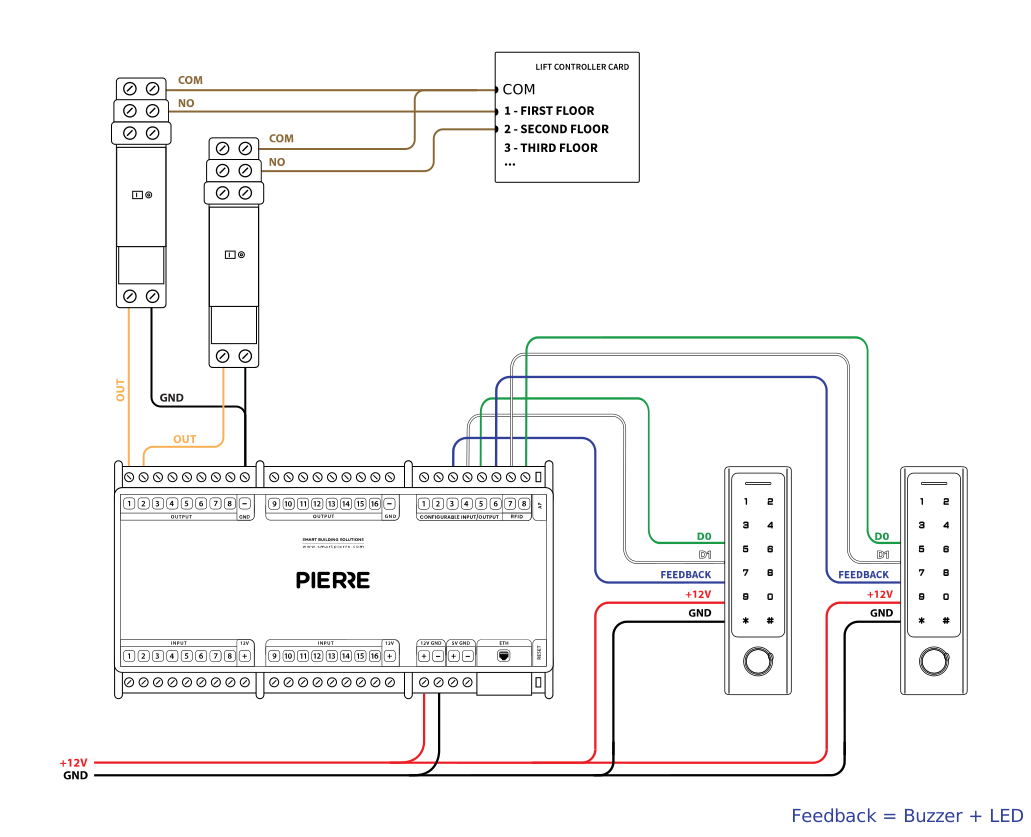
Elevator Control - Floor-by-Floor control - Electric schemes
Schemes - Inside the elevator
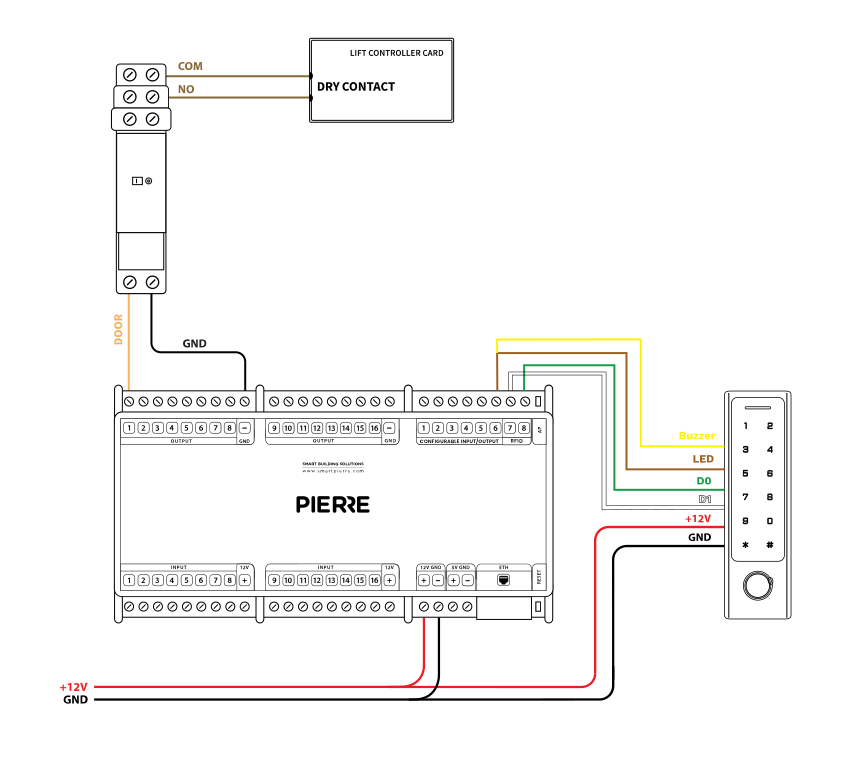
Elevator Control - Inside the Elevator - Electric schemes
Cables - Floor-by-floor control
| Position | Wires | Diameter | Type | Comment |
|---|---|---|---|---|
| From PIERRE to Mechanical Relay | 2 | 0.75 mm² | H07V-K | GND, OUT |
| From PIERRE to RFID reader | 5 | 0.5 mm² | Cat5 UTP | +12V, GND, D0, D1, FEEDBACK |
| From Mechanical Relay to Lift Controller Card | 2 | 0.75 mm² | H07V-K | COM, NO |
Cables - Inside the elevator
| position | wires | diameter | type | comment |
|---|---|---|---|---|
| From PIERRE to Mechanical relay | 2 | 0.75 mm² | H07V-K | GND, OUT |
| From Mechanical Relay to Lift Controller Card | 2 | 0.75 mm² | H07V-K | COM, NO |
| From PIERRE to RFID reader | 5 | 0.5 mm² | Cat5 UTP | +12V, GND, D0, D1, FEEDBACK |
Cables - Hybrid Destination Control
| position | wires | diameter | type | comment |
|---|---|---|---|---|
| From cabin RFID reader to each PIERRE controller | 5 | 0.5 mm² | Cat5 UTP | +12V, GND, D0, D1, FEEDBACK — D0/D1 in parallel to all controllers; see Keep in Mind regarding FEEDBACK |
| From PIERRE to Mechanical Relay (per floor) | 2 | 0.75 mm² | H07V-K | GND, OUT |
| From Mechanical Relay to Lift Controller Card (per floor) | 2 | 0.75 mm² | H07V-K | COM, NO |
| Ground floor contact from every PIERRE controller | 2 | 0.75 mm² | H07V-K | COM, NO — wired in parallel from all controllers (wired-OR) |
FAQ
The lift is controlled by its own safety-certified controller; PIERRE only sends call and floor-enable signals to it. During an outage the lift behaves as its manufacturer defines (usually it stops or returns to a floor on its emergency supply). PIERRE resumes sending signals as soon as it is powered again.