Solution - Open/Close Door Locks
Description
Electric locks can be integrated into the PIERRE system and controlled from an appropriate PIERRE Controller output.
An unlock command can be triggered in several ways, including:
-
the Smart PIERRE application,
-
a local push button,
-
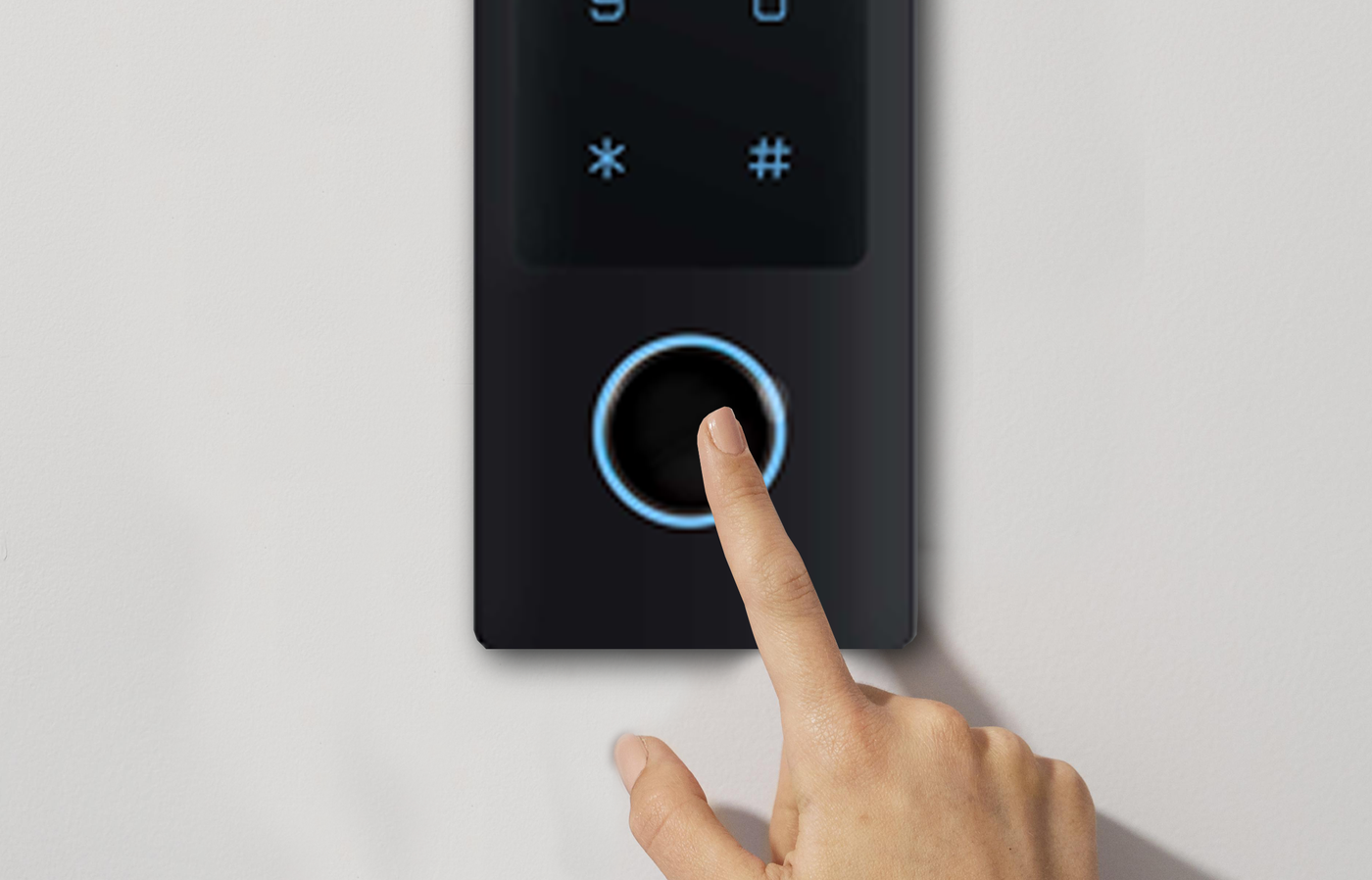
a PIERRE RFID / PIN access control unit or other compatible access control device,
-
an intercom system,
-
Scenes or Automations.
The exact control and wiring method depends on the type and operating principle of the electric lock.
Fail Safe and Fail Secure
When selecting an electric lock, it is important to determine how the door should behave in the event of a power failure.
Fail Safe
A Fail Safe lock becomes unlocked when power is lost.
This type of lock typically requires continuous power to maintain the locked state.
Fail Secure
A Fail Secure lock remains locked when power is lost.
Electrical power is required to unlock the door.
The appropriate operating principle must be selected according to the function of the door, access control requirements, the project's security design, and applicable fire and building regulations.
Integration
The electric lock can be integrated with the PIERRE Controller through a wired connection.
Control can be combined with different access methods, including:
-
local push buttons,
-
RFID,
-
PIN codes,
-
intercom,
-
Smart PIERRE application,
-
Automations.
Where an access control device, such as an RFID reader, is directly associated with a specific electric lock, the related input and the output controlling the lock must be connected according to the required PIERRE system architecture.
Automation Applications
Electric locks can be combined with different PIERRE functions and automations.
For example:
-
unlocking a door based on a valid RFID, PIN, or other authorized credential,
-
controlling the lock at a specified time,
-
activating a lighting Scene after an access event,
-
using an access event as a condition for another Automation,
-
unlocking the door from the intercom system.
Access During a Power Failure
With the appropriate system design, the PIERRE access control system can be backed up using a 7 Ah UPS battery, allowing access control to remain operational for a limited period during a mains power failure.
For backup operation, all devices required for access must be powered from the PIERRE UPS power supply, including:
-
the PIERRE Controller,
-
the PIERRE RFID / PIN access control unit,
-
and the 12 V DC electric lock.
With appropriate wiring and system design, a 7 Ah UPS battery can typically maintain access control operation for approximately 1–2 hours during a power failure.
The actual backup time depends on the total current consumption of the connected devices, the type and operating mode of the electric lock, and the capacity, condition, and age of the battery.
If continued electrical access is not available after the backup supply is depleted, access during an extended power failure must be provided according to the door and lock design, for example through an appropriate mechanical or emergency access method.
Power Supply and Sizing
-
The lock supply voltage and current consumption must be compatible with the PIERRE system and the associated power supply.
-
For the PIERRE UPS-backed access control configuration described above, a 12 V DC electric lock must be used.
-
The power supply must be sized according to the maximum simultaneous current consumption of all connected locks and access control devices.
-
When multiple electric locks are used, the current consumption of all locks must be considered when sizing the power supply.
-
Higher-current locks may require a suitable intermediate relay or another switching device rated for the connected load.
-
Where backup operation is required, the power requirements of all PIERRE, access control, and network devices necessary for the intended access function must be considered.
Technical Notes
-
Before wiring, verify the lock's rated voltage, maximum current consumption, and operating principle.
-
For electromagnetic and other inductive locks, the switching device and any required surge suppression must be selected according to the manufacturer's requirements for the lock and switching device.
-
Cable cross-section must be selected according to the lock current, cable length, and permitted voltage drop.
-
Before handover, the actual Fail Safe / Fail Secure behavior of the door must also be tested with the mains power disconnected.
-
For escape routes, fire-rated doors, or other safety-related doors, the electric lock and release method must be selected according to applicable fire, building, and safety regulations.
-
PIERRE access control must not replace or bypass any required mechanical release, emergency release, escape, or fire-safety function of the door.
-
Installation must be carried out according to the electric lock manufacturer's documentation, the applicable PIERRE technical documentation and wiring diagram, and the project's electrical and access control design.
Schemes - Simple lock
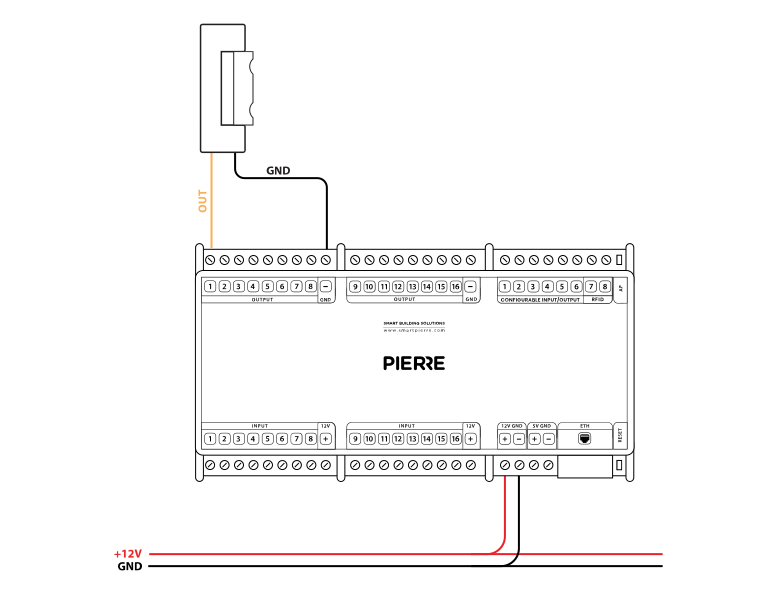
Wiring door in PIERRE - 12V - Electric schemes
Cables - Simple lock
| Position | Wires | Diameter | Type | Comment |
|---|---|---|---|---|
| From PIERRE to Simple lock | 2 | 0.75 mm² | H07V-K | OUT, GND |
Schemes - Simple lock and door sensor
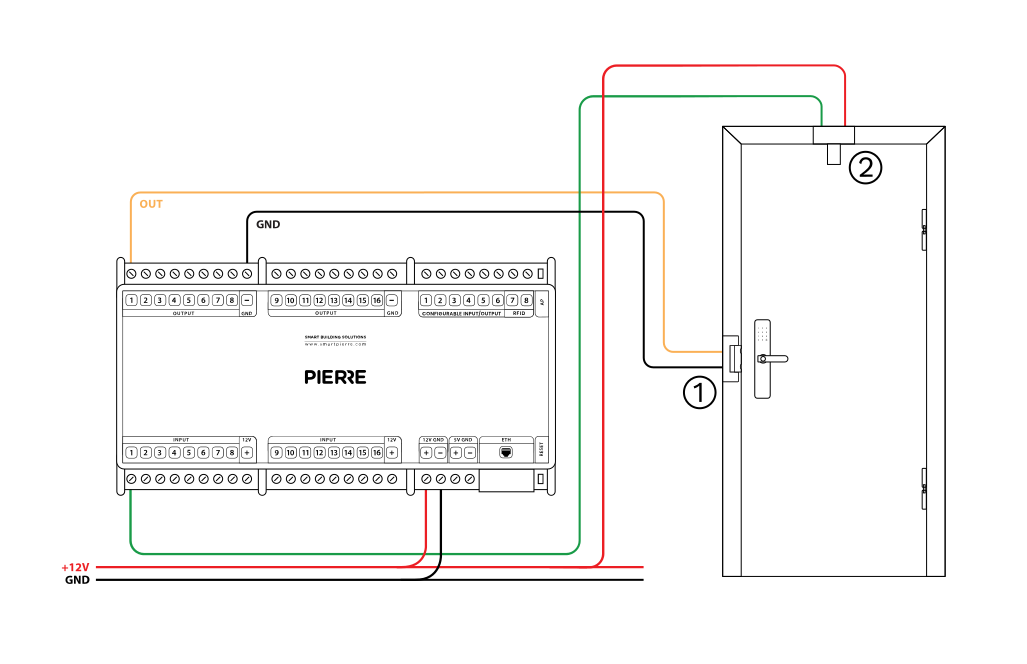
Access control module – Electric lock and door sensor wiring - Electric schemes
Cables - Simple lock and door sensor
| Position | Wires | Diameter | Type | Comment |
|---|---|---|---|---|
| From PIERRE to Simple lock | 2 | 0.75 mm² | H07V-K | OUT, GND |
| From PIERRE to Door sensor | 2 | 0.5 mm² | H07V-K | IN, +12V |
Schemes - Holding magnet
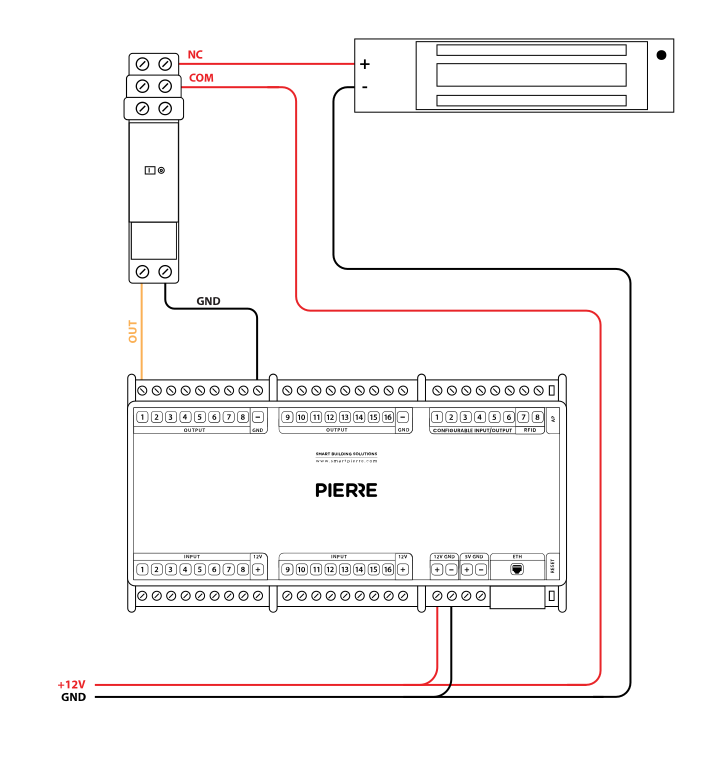
Wiring magnetic Fail Safe door lock in PIERRE - 12V - Electric schemes
Cables - Holding magnet
| Position | Wires | Diameter | Type | Comment |
|---|---|---|---|---|
| From PIERRE to Relay | 2 | 0.75 mm² | H07V-K | OUT, GND |
| From Relay to Holding magnet | 2 | 1 mm² | H07V-K | COM, NC |
| From PIERRE to Door sensor | 2 | 0.75 mm² | H07V-K | IN, GND |
Schemes - Simple lock, door sensor, RFID and UPS
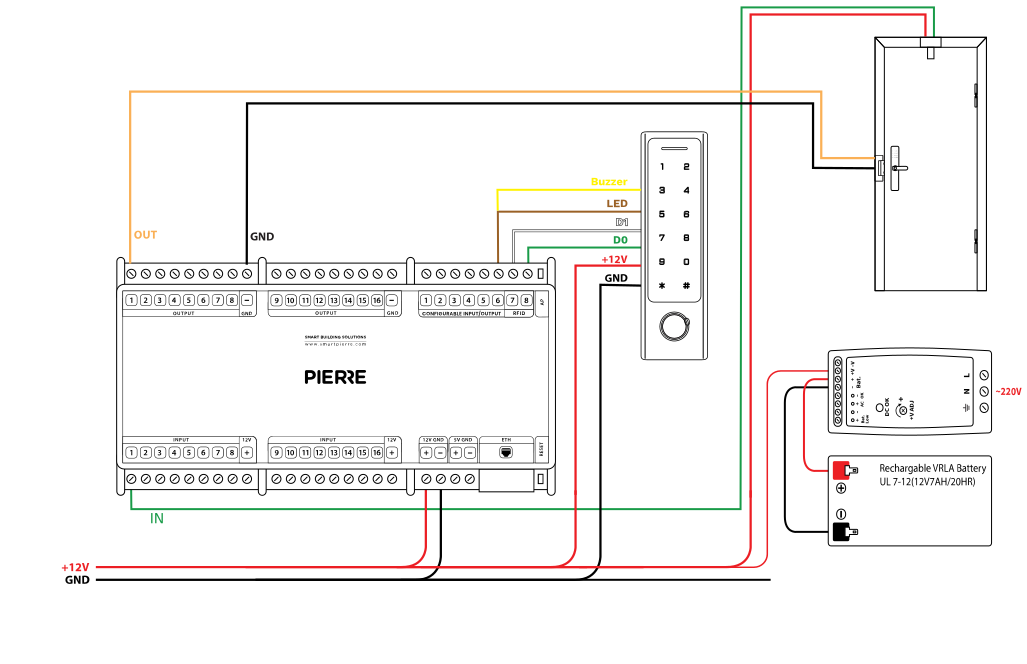
Cables - Simple lock, door sensor, RFID and UPS
| Position | Wires | Diameter | Type | Comment |
|---|---|---|---|---|
| From PIERRE to Simple lock | 2 | 0.75 mm² | H07V-K | OUT, GND |
| From PIERRE to Door sensor | 2 | 0.5 mm² | H07V-K | IN, +12V |
| From PIERRE to RFID | 5 | Cat5 | UTP | +12V, GND, D0, D1, Feedback |
| From Power Supply to Battery | 2 | 1 mm² | H07V-K | Batt+, Batt- |
Troubleshooting
Green – Online: the controller is connected to the network and operating normally. Red – Offline: the controller is disconnected from the network, or there is no internet access. White – Commissioning: the controller has started in commissioning mode and is waiting to be commissioned. Light blue – AP mode: the controller is broadcasting its own network for setup or configuration. Dark blue – Selected in the app: the controller is currently selected in the PIERRE Partner app, which helps you identify the physical controller in the cabinet. Purple – Searching for IP address: the controller is waiting to receive an IP address from the router. Orange – Firmware update: a firmware update is in progress; do not power off the controller while the LED is orange.
If not: Add it in the PIERRE Partner app.
If not, wire it as shown in the diagram. To rule out the lock and its cable, disconnect the lock wire from the controller output and briefly connect it to +12 V: if the lock clicks, everything after the controller works. Alternatively move the lock to another free output and change the pin in the PIERRE Partner app.
Mount the sensor so that it closes when the door or gate is fully closed. The sensor only distinguishes closed from not closed, so a half-open door is reported as open — which is what you want to know.
Controllers and devices keep their last state and resume when power returns. Locks and gate motors can be backed up by a battery so they keep working during an outage — and always keep a manual way to open them.
Each electric strike has a specified strength limit, which can be found in the product details.
This depends on the setup. The lock can be connected to the PIERRE system, the intercom, or both if the intercom has additional unlocking features.