Solution - ON/OFF HVAC - Passive Heating Cooling (heating pumps)
Description
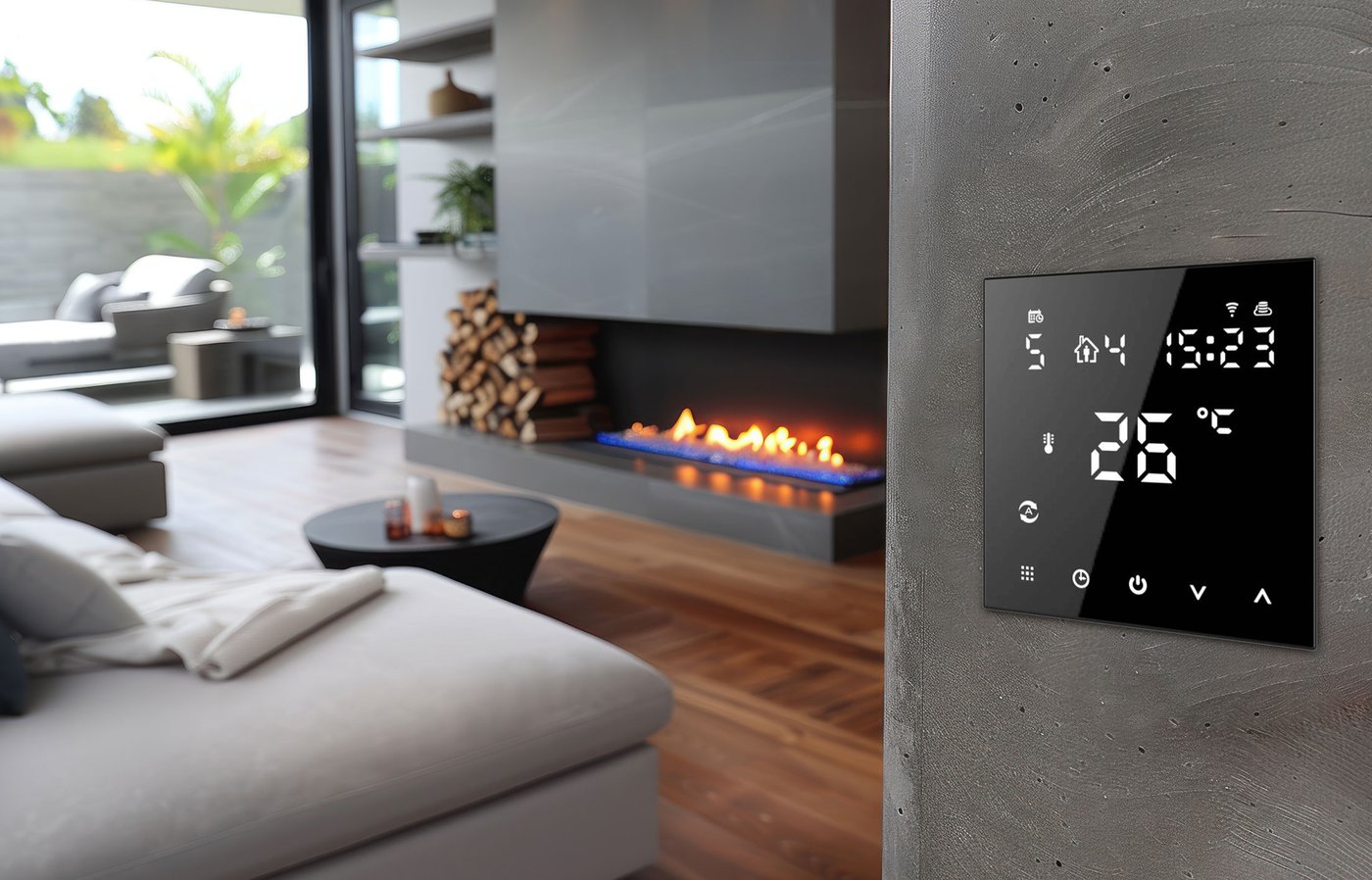
On/Off Heating and Cooling control uses a switching output of the PIERRE Controller together with a temperature sensor to control heating or cooling demand.
The operation is similar to a traditional thermostat: the PIERRE system compares the measured temperature with the configured target temperature and switches the corresponding heating or cooling output on or off according to demand.
Operating Principle
-
The temperature sensor continuously provides the current measured temperature.
-
The PIERRE system compares this value with the configured target temperature.
-
When heating or cooling is required, the corresponding output is activated.
-
When the target temperature is reached, the output is switched off according to the configured control logic.
-
The hysteresis value defines the switching range around the target temperature, helping to prevent excessive switching.
This is a two-state control method: the controlled output is either active or inactive. It does not provide continuous control such as 0–10 V output regulation.
Compatible Equipment
On/Off control can be used with heating and cooling equipment that provides a suitable switching or external thermostat input, including:
-
heat pumps,
-
simple heating systems,
-
electric heating systems,
-
HVAC equipment with an On/Off thermostat input,
-
boilers or other heat generators with a suitable external control input,
-
other equipment designed to accept a thermostat-type switching command.
Compatibility must always be verified according to the manufacturer's documentation of the connected equipment.
Automation Applications
On/Off heating and cooling can be combined with other PIERRE functions and automations.
For example:
-
different daytime and nighttime target temperatures,
-
adjusting the target temperature according to a schedule,
-
modifying heating or cooling demand when an open window is detected,
-
using a reduced target temperature when the room is unoccupied,
-
applying different operating modes through Scenes or Automations.
Hysteresis
Hysteresis prevents the system from repeatedly switching on and off due to small temperature fluctuations around the target temperature.
The appropriate hysteresis value should be selected according to the operating characteristics of the connected heating or cooling system.
For compressor-based equipment, it is particularly important to follow the manufacturer's specified minimum operating and restart times and to avoid excessive switching.
Technical Notes
-
Before wiring, verify the type and electrical requirements of the external control or thermostat input of the connected HVAC equipment.
-
If the equipment requires a potential-free / dry-contact thermostat input, an appropriate potential-free contact must be provided from the PIERRE system. External voltage must not be applied to the thermostat input unless explicitly permitted by the equipment manufacturer.
-
If a PIERRE output directly switches an electrical load, verify the permitted switching voltage, current, and load type of the output.
-
If the connected load exceeds the permitted switching capacity of the PIERRE output, a suitable relay or contactor must be used.
-
For compressor-based HVAC equipment, excessive switching must be avoided. The switching and restart requirements specified by the manufacturer must be followed.
-
The room temperature sensor should be installed in a representative location, away from direct heat sources, cooling equipment, direct sunlight, and strong airflow.
-
Wiring and configuration must be carried out according to the PIERRE technical documentation, the connected equipment manufacturer's documentation, and the project's mechanical and electrical design.
Schemes
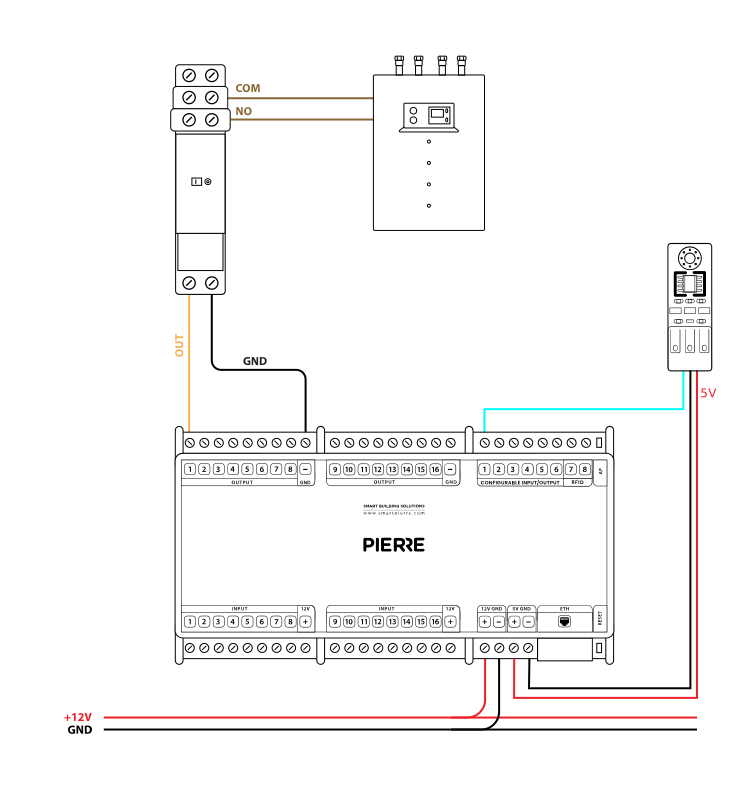
On/Off HVAC - Electric schemes
Cables
| Position | Wires | Diameter | Type | Comment |
|---|---|---|---|---|
| From PIERRE to Mechanical Relay | 2 | 0.75 mm² | H07V-K | OUT, GND |
| From Temp Sensor to PIERRE | 3 | Cat6 | SFTP | +5V, GND, SIGNAL |
| From Relay to Heat Pump | 2 | Cat6 | SFTP | COM, NO |
Troubleshooting
The sensor is not delivering data and the app may be showing the last value received. Check the sensor wiring and its connection to the controller; if the wiring is fine, replace the sensor.
About 1.5 m above the floor on an interior wall, away from direct sunlight, radiators, draughts and electronics, where it measures the room air.
If the power goes out, smart devices will retain their last state and resume functionality when power is restored. For critical devices, battery backups can be used to maintain operation during an outage.
No, a classic thermostat is not necessary. Instead, a temperature sensor integrated with the PIERRE system can monitor the room’s temperature and manage the heating/cooling devices accordingly.
Yes, PIERRE offers its own smart thermostats, which can be found in the thermostat product category.
Yes, you can replace an old thermostat with a PIERRE display, as long as the display includes a temperature sensor for temperature monitoring.
Yes, most PIERRE displays have built-in temperature sensors and can control heating/cooling systems just like a thermostat. All displays have relays that can send signals to heating/cooling devices to turn them on or off.
Heat meters with an M-Bus interface are read through an Intesis M-Bus to Modbus gateway connected to a PIERRE Pro controller. The meters are wired to the gateway's M-Bus (a shared two-wire bus) and the controller reads them over Modbus RTU.
Yes, you can control the temperature room by room.
The circulation pump’s operation is based on automation, so if the valve in any apartment’s floor heating system is activated, it simultaneously activates the circulation pump. If separate control is needed, it can only be handled locally within the apartment.
Each apartment measures its own temperature and humidity and controls the valves on its distribution manifold. The circulation pump of the floor (or of the building) is switched on by automation whenever any manifold valve on that floor is open, and off again when all valves are closed.
Yes, per manifold: an automation opens the valve when the room temperature drops below the set point and starts the pump once the valve is open (or after a short delay).
The heat pump can be controlled by PIERRE in two ways: • Potential-free contacts: one contact switches winter/summer mode, another starts and stops the heat pump. • Modbus RTU: consult the manufacturer or distributor in advance about the Modbus register addresses and documentation for the heat pump model.
The motorized valves for underfloor heating zones can be controlled without any issues by the PIERRE system, whether they are On-Off or 0-10V valves. In the mechanical room, the PIERRE system handles the following controls: winter-summer mode switching via a potential-free contact, circulation pump control, hot water circulation pump control, and 0-10V mixing valve control with supply water temperature measurement.