Solution - Heat Recovery Unit (Recuperator)
Description
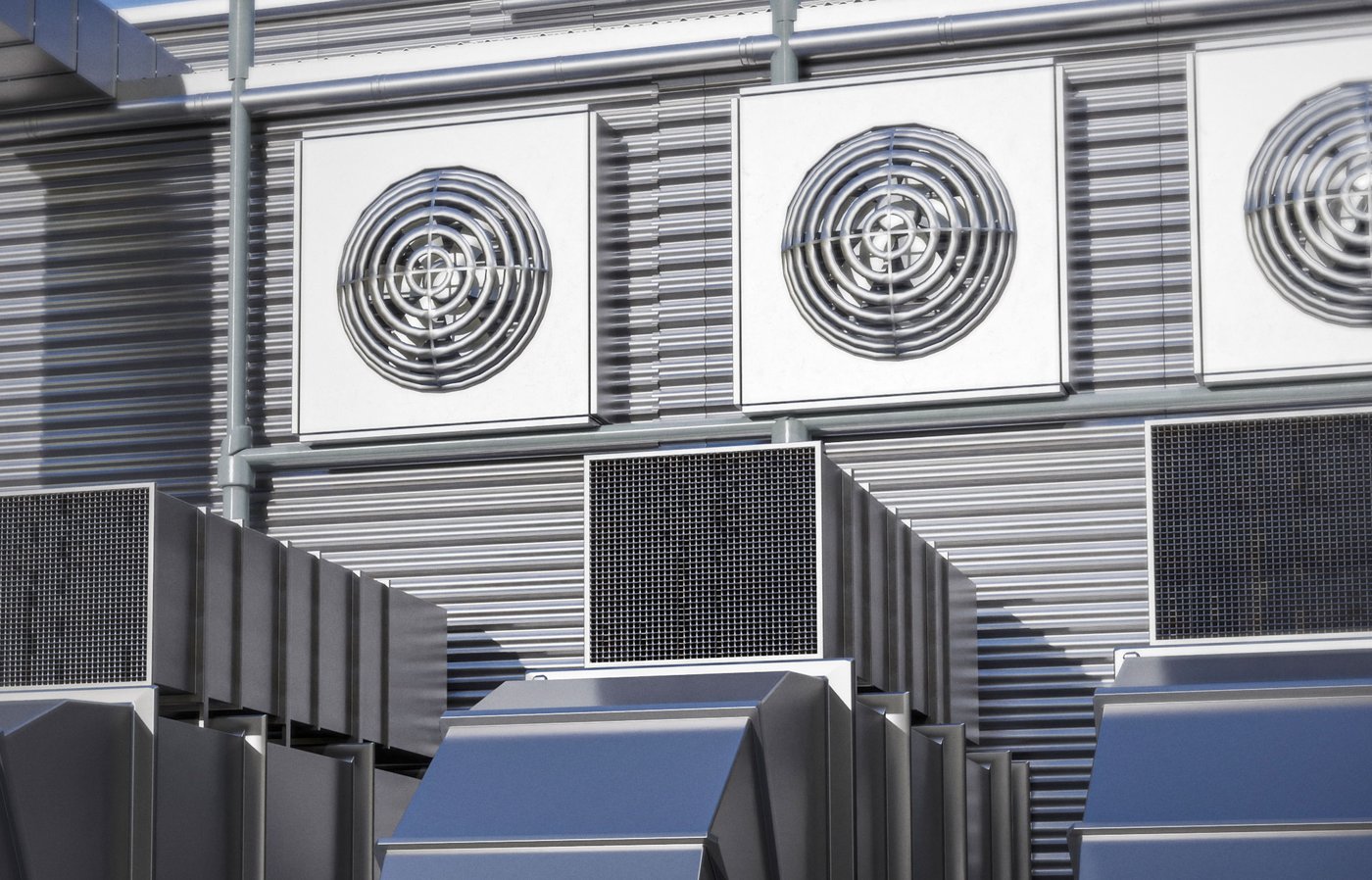
A recuperator, or heat recovery ventilation unit, transfers part of the heat energy from the outgoing air to the incoming fresh air, providing ventilation while reducing heat loss associated with air exchange.
Compatible recuperators can be integrated into the PIERRE system. Depending on the available control interface, the unit can be switched on and off, and its ventilation intensity or fan speed can also be controlled.
Control
Recuperator control within the PIERRE system depends on the control interface supported by the specific unit.
Available functions may include:
- On/Off – Switching the unit on and off.
- Fan Speed / Intensity – Adjusting the fan speed or ventilation intensity.
- Manual Control – Manual operation through the PIERRE system.
- Scenes and Automations – Operation through Scenes and Automations.
Control and Wiring Options
Before wiring, always verify the external control interfaces supported by the recuperator.
Depending on the unit, control may be implemented using:
- dry contact / relay inputs,
- separate inputs for fixed fan speed levels,
- a 0–10 V control signal,
- or an appropriate external interface provided by the recuperator's own control unit.
For units with fixed fan speed levels, each speed may require a separate control signal. Where required by the unit, the control logic must ensure that incompatible speed commands cannot be active simultaneously.
The exact wiring must always follow the manufacturer's documentation for the specific recuperator and the applicable PIERRE wiring diagram.
Automation Applications
The operation of the recuperator can be automated based on different sensors, schedules, and system conditions.
Presence Sensor
Based on presence detection, ventilation can be activated or increased to a higher intensity. When the room is no longer occupied, the system can return the unit to a lower ventilation level.
Humidity and Air Quality
Ventilation intensity can be automatically increased based on humidity or air quality values and reduced again when the required conditions are reached.
Window and Door Contact
The detection of an open window or door can be used to modify the operation of the recuperator. The exact control logic should be defined according to the building's mechanical system and the intended ventilation strategy.
Time-Based Control
The recuperator can operate automatically at specified times or during defined periods, for example during a morning ventilation period or according to the building's occupancy schedule.
Heating and Cooling Integration
Ventilation operation can be coordinated with the heating and cooling automations of the PIERRE system.
Technical Notes
- Before wiring, verify the recuperator's external control interface, supply voltage, control logic, and electrical requirements.
- For units with fixed fan speed levels, the required number of control outputs and their switching logic must be determined according to the documentation of the specific recuperator.
- 0–10 V control may only be used with recuperators that provide a compatible 0–10 V control input.
- The recuperator's own frost protection, motor protection, thermal protection, and other factory safety functions must remain active. These functions must not be replaced or bypassed by the PIERRE system.
- Filter inspection, cleaning, and replacement remain part of the regular maintenance of the recuperator and must be performed according to the intervals specified by the manufacturer.
- Installation and wiring must be carried out according to the recuperator manufacturer's documentation, the applicable PIERRE technical documentation and wiring diagram, and the project's mechanical and electrical design.
Schemes - Phase control
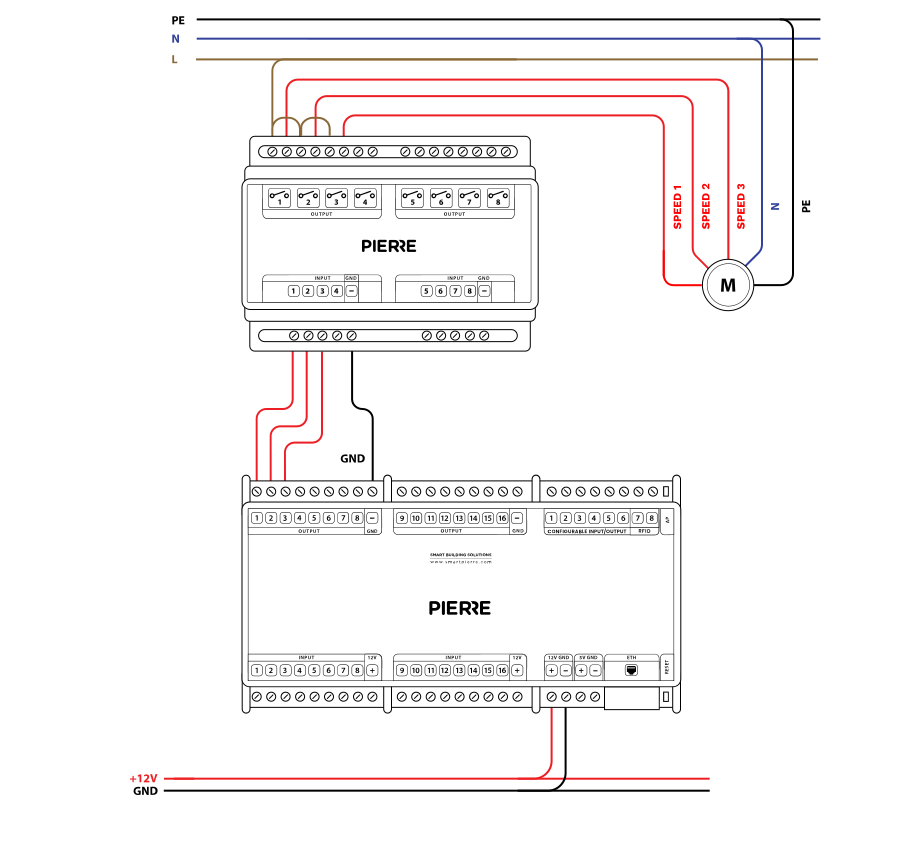
Recuperator - Electric schemes
Cables - Phase control
| Position | Wires | Diameter | Type | Comment |
|---|---|---|---|---|
| From relay to Recuperator | 5 | 1.5 mm² | NYM-J | SPEED1, SPEED2, SPEED3, N, PE |
| From PIERRE Controller to relay | 4 | 0.75 mm² | H07V-K | OUT1, OUT2, OUT3, GND |
Schemes - 0-10V control
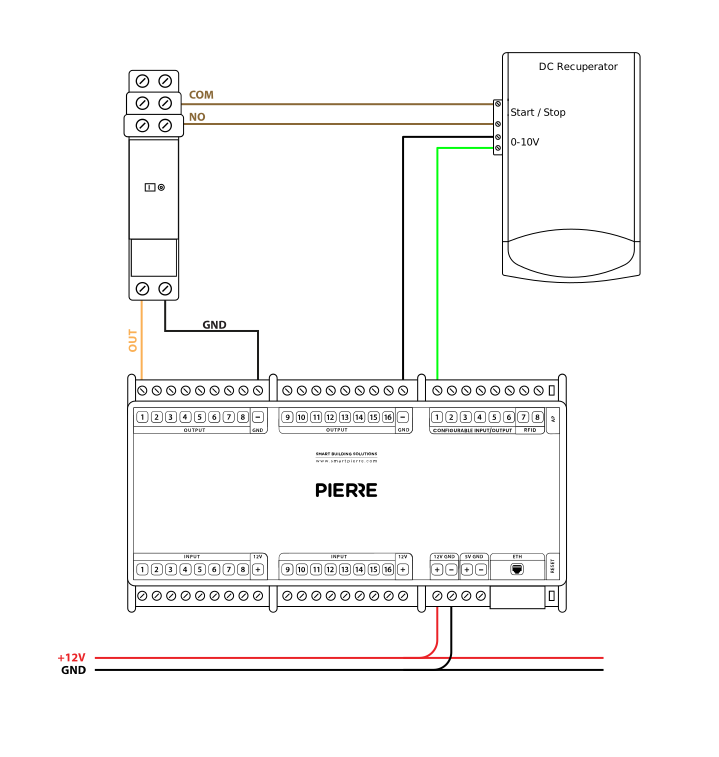
Recuperator - Electric schemes
Cables - 0-10V control
| Position | Wires | Diameter | Type | Comment |
|---|---|---|---|---|
| From PIERRE to Relay | 2 | 0.75 mm² | H07V-K | OUT, GND |
| From Relay to Recuperator | 2 | 0.75 mm² | H07V-K | COM, SIGNAL |
| From PIERRE to Recuperator | 2 | 0.75 mm² | H07V-K | 0-10V, GND |
FAQ
If the power goes out, smart devices will retain their last state and resume functionality when power is restored. For critical devices, battery backups can be used to maintain operation during an outage.
No, a classic thermostat is not necessary. Instead, a temperature sensor integrated with the PIERRE system can monitor the room’s temperature and manage the heating/cooling devices accordingly.
Yes, PIERRE offers its own smart thermostats, which can be found in the thermostat product category.
Yes, you can replace an old thermostat with a PIERRE display, as long as the display includes a temperature sensor for temperature monitoring.
Yes, most PIERRE displays have built-in temperature sensors and can control heating/cooling systems just like a thermostat. All displays have relays that can send signals to heating/cooling devices to turn them on or off.
Heat meters with an M-Bus interface are read through an Intesis M-Bus to Modbus gateway connected to a PIERRE Pro controller. The meters are wired to the gateway's M-Bus (a shared two-wire bus) and the controller reads them over Modbus RTU.
Yes, you can control the temperature room by room.