Solution - Fan/Motor
Description
A fan or motor output is used for room ventilation — exchanging air with the outside, or moving air between rooms. It is wired through a relay and driven by a PIERRE Pro or Lite controller.
Wiring
- The fan is powered from its own circuit; the relay only switches it.
- One relay output per fan for a single-speed unit.
- A multi-speed fan needs one output per speed, interlocked so two speeds are never energised together.
- A motor above the relay rating is switched through a contactor: the relay drives the coil, the contactor carries the load.
Control
- On and off from the app and from wall buttons.
- Scheduled operation, for example a fixed daily ventilation period.
- Condition-based operation from a sensor — temperature, humidity or CO2 — with a timeout that keeps the fan running after the condition clears.
Technical Notes
- Check the fan's starting current, not only its rated current; the inrush is what determines the relay or contactor size.
- Inductive loads should be suppressed at the load side to protect the switching contacts.
- A fan that extracts air needs a matching air inlet, otherwise it works against a closed room and moves very little air.
- Keep a local isolation point for servicing the fan.
Schemes - Fan with low consumption
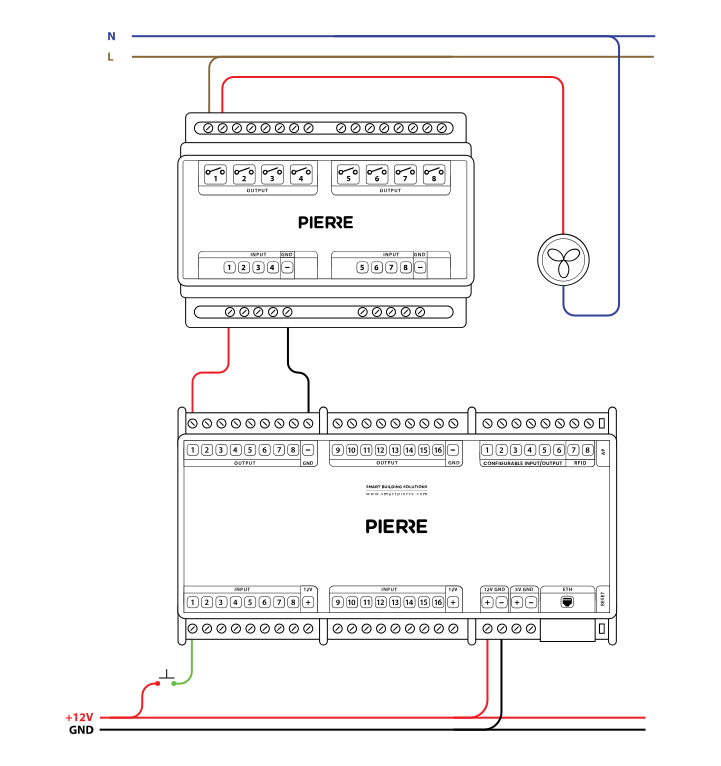
Wiring-Fan Control in the PIERRE smart home system - Electric schemes
Schemes - Fan with high consumption
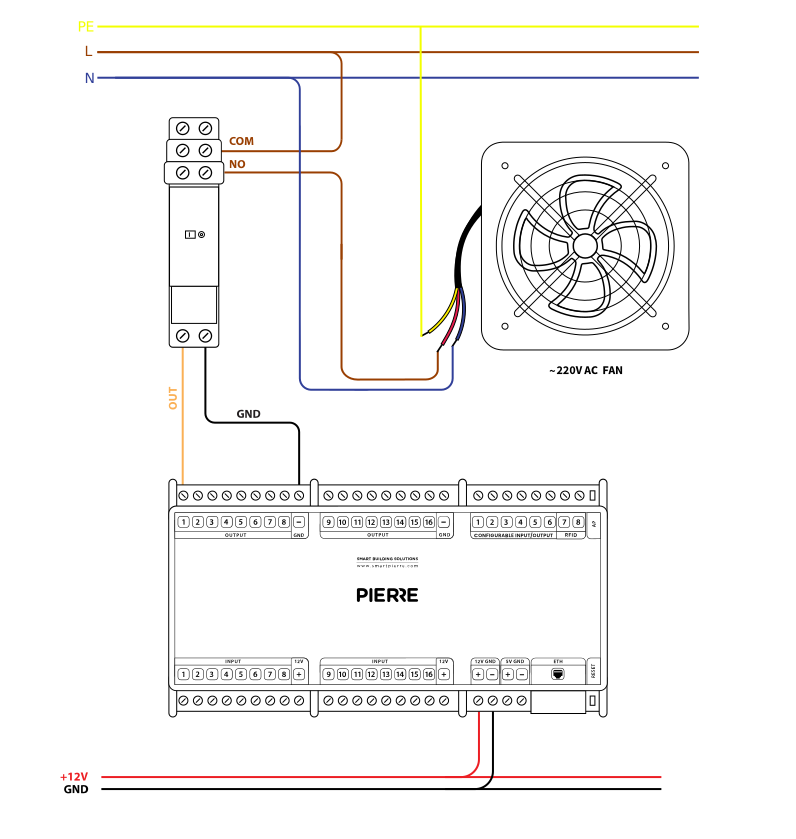
Wiring Fan in the PIERRE smart home system - Electric schemes
Cables - Fan with low consumption
| Position | Wires | Diameter | Type | Comment | Category |
|---|---|---|---|---|---|
| From relay to Fan | 2 | 1.5 mm² | NYM-O | L, N | Required |
| From PIERRE Controller to relay | 2 | 0.75 mm² | H07V-K | GND, OUT | Required |
| From Push button to PIERRE | 2 | 0.25 mm² | UTP | +12V, IN | Optional |
Cables - Fan with high consumption
| position | wires | diameter | type | comment |
|---|---|---|---|---|
| From Mechanical relay to Fan | 2 | 1.5 mm² | NYM-O | L, N |
| From PIERRE to Mechanical relay | 2 | 0.75 mm² | H07V-K | GND, OUT |
Troubleshooting
If not, the fault is not in PIERRE. Check that the fan or motor is wired correctly and has power. To bypass the controller, connect the relay's control wire directly to +12 V: the fan must start.
If not: Check internet connectivity.
If not: Add it in the PIERRE Partner app.
If not: check the polarity of the GND and OUTPUT wires at the relay coil; they may be reversed. To rule out a relay fault, feed 12 V DC from the power supply directly to the relay coil input instead of the controller output.
If not, check every connection on the relay: is the line (L) connected, and are the right wires on the relay terminals?
The simplest fan coil units to control are those that can be turned On and Off via relays, with each speed level controlled by separate relays. There are also fan coils that can be controlled using a 0-10V signal, which can also be integrated into the system. Additionally, Modbus communication is possible, but in this case, it is important to consult the manufacturer or supplier in advance regarding the Modbus register addresses and the necessary detailed documentation to ensure the control process is implemented correctly.